Put your HTML text here Functional field | Functional Composition
Adjacent and connected functionality

Map the functional field.

Explore composition alongside configuration, modeling, planning, orchestration, governance and other distinct capabilities.

Functional adjacency

Related does not mean equivalent.

Each connection is a research hypothesis to classify as constituent, prerequisite, interface, alternative, companion, result—or unrelated.

FUNCTIONAL COMPOSITION
Forming an intended working whole from differentiated elements

Configuration

Which components are admissible and compatible?

Preparation / constituent

Modeling

How is a working whole represented?

Constituent / interface

Semantics

How are meanings and references kept stable?

Prerequisite / companion

Planning

Which possible routes satisfy desired conditions?

Possible constituent

Orchestration

How is an established arrangement coordinated?

Operational companion

Transactions

Which state transitions are permitted and recorded?

Operational companion

Verification

How are assumptions, bindings and outputs checked?

Assurance companion

Governance

What may proceed, be relied upon or accepted?

Qualification / control

Adaptation

How does composition change under new conditions?

Dynamic extension

Performance

Does this arrangement improve cost, quality or time?

Measured outcome
Treatments and position

Research coordinates, not a ten-step ritual.

Choose a treatment appropriate to the present burden; record where the research currently stands.

COMPOSITION

Where is this work?

ACompose
Assemble
OOperate
Constructively
IInteract
Confidently
UUnderstand
Coherently
EExamine
Carefully
POSITION

Where is this work?

BeforeIdentify whether sufficient basis exists.
PrepareGather sources and establish conventions.
StartBegin a bounded research pass.
FinishComplete the intended comparison.
AfterInspect implications and consequences.
TREATMENT

How are we working it?

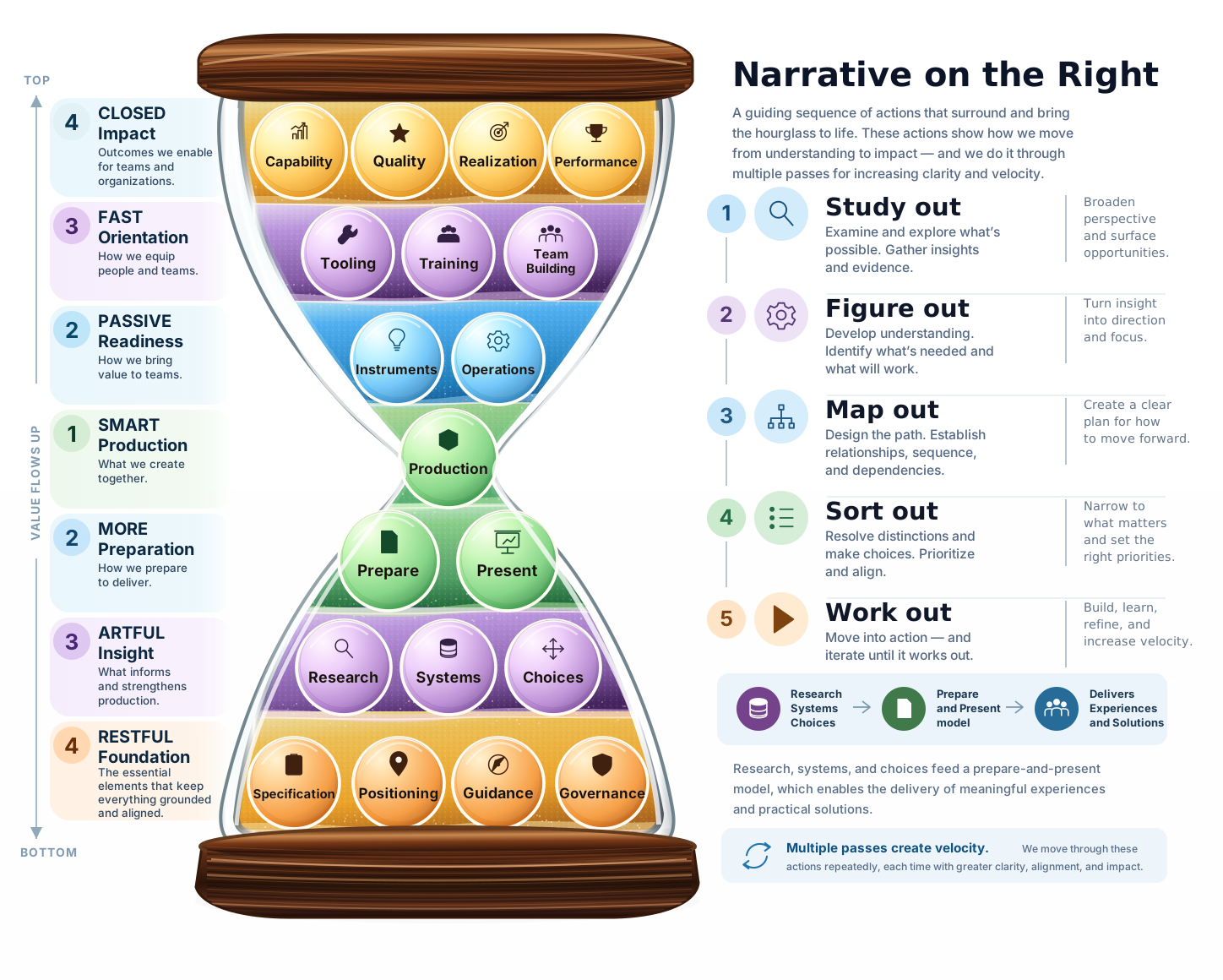
Study OutLocate reliable publications, native definitions, figures and claims.
Figure OutExplain each component and causal mechanism in its own language.
Map OutLocate relationships, interfaces, dependencies and adjacent fields.
Sort OutQualify, classify and retain what each source actually warrants.
Work OutConstruct and test candidate compositions when appropriate.
IMAGE TEST ONE

Can we work with this WEBP?

How-To Library

effective learning
Study OutLocate reliable publications, native definitions, figures and claims.
IMAGE TEST TWO

Can we work with this SVG?

How-To Library

effective learning
Study OutLocate reliable publications, native definitions, figures and claims.
{section_intro('Continuing research','Questions our map should help answer.','Find technical interfaces and genuine differences rather than assuming universal equivalence.')}
Which representations are composable versus merely comparable?
Where is compatibility checked, and under which conditions?
How does a composed model become executable?
What is the boundary between operation and accepted result?
Which mechanisms can be adopted without importing an entire architecture?
What claims have source evidence versus only a candidate explanation?